
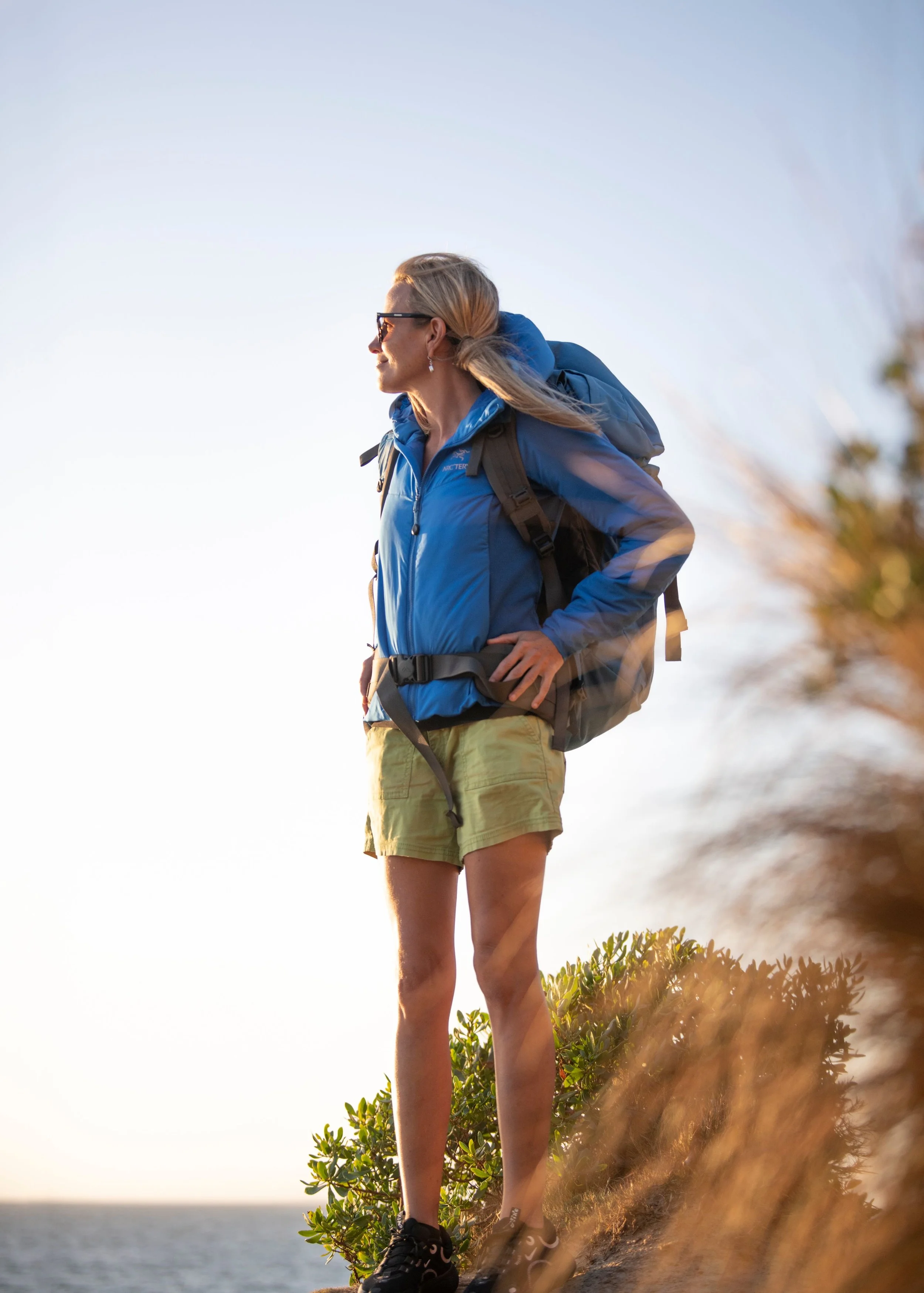
About Me
My Story
I was born in 1971 and grew up in the Dandenong Ranges on the edge of Melbourne. As a little girl, I was happiest outdoors, often perched high in the branches of a chestnut tree, gazing at the hills beyond. That sense of freedom and possibility never left me.
When I was eight, after admiring a painting of a mountain and leafing through mountaineering books at my grandparents’ house, my grandpa gave me a small brooch shaped like an ice axe and mountaineering boot. From that moment, the dream of becoming a mountaineer was planted.
In my teens, bullying and the struggle to “fit in” pulled me off course. I left school early, lost my confidence, and threw myself into rebellion — hanging out with punks, skinheads, graffiti artists, and anyone else who lived on the edges. I was searching for belonging, but mostly I felt adrift.
Everything shifted when I discovered a vocational Year 12 course in outdoor education. Rock climbing, rafting, skiing, and bushwalking rebuilt my self-belief, and from there I pursued a life in the outdoors — working as an outdoor educator, ski instructor, and eventually completing degrees in Outdoor Education, Education, and later, Leadership and Positive Psychology.
Life then took me in other directions. I became a mother of three, raised my children across four continents, and took on leadership roles in schools in Australia, Vietnam, South Korea, and the US. The dream of mountaineering quietened, but it never disappeared.
Living with MS
In 2008, after years of unexplained health episodes, I was told I might have Multiple Sclerosis. In 2018, I was officially diagnosed. My neurologist warned that if progression continued unchecked, I could be in a wheelchair within a few years.
Instead of stepping back, I chose to step forward. I left my role as a school principal in 2021 to pursue my mountaineering dream — not only for myself, but to raise awareness and funds for MS research.
MS is unpredictable. Some days it means fatigue, dizziness, or cognitive challenges. But it has also given me clarity: life is too precious to wait. Mountains became both my training ground and my metaphor — showing me what it means to live with courage, adaptability, and purpose.
In 2023, I became the first Australian with MS to reach 8,000m on Everest. The disappointment of turning back before the summit was intensified by the knowledge that MS is unpredictable. But I returned grateful — Mavenclad is keeping my MS stable for now, and I have the strength and capacity to continue climbing at the very highest level.
Mountaineering Journey
My return to the mountains began in 2022. On Mera Peak (6,476m) I took my first steps into true mountaineering — roped up, in crampons, setting out under a headlamp in the thin air above 6,000m. I summited while battling COVID, and even through the exhaustion, I knew I had found my place.
Later that year, I attempted Ama Dablam (6,500m), the dream mountain I had first seen in 1995. Technical, beautiful, and demanding, it taught me precision, trust, and calm under pressure.
In 2023, I stood at the South Col of Mt Everest (8,000m) and spent a night alone at that altitude. It was not the summit, but it was proof: my body is capable of operating at extreme altitude, and I am capable of returning. That understanding now shapes my return to Everest in 2026.
In 2024, I guided a group of people with MS to Everest Base Camp (5,364m) — an expedition about inclusion and solidarity, proving that adventure belongs to all of us.
Each climb has shaped me in a different way: some tested my endurance, others fulfilled a decades-long dream, and all of them deepened my love for the Himalayas.
Why I Climb
For me, mountaineering is not just about standing on summits. It’s about identity, resilience, and possibility. Every climb I’ve undertaken has raised funds for MS research and awareness for invisible challenges. But more than that, each climb has been a way of asking — and answering — bigger questions:
Who are we, when tested by uncertainty?
What are we truly capable of?
How do we rise, even when the outcome isn’t guaranteed?
Everest 2026 is the next step in this journey. It’s not only a chance to return to something unfinished, but a platform to open doors to conversations that matter — about courage, representation, and the power we all have to face our own mountains.
In 2026, I return to Everest alongside Phunjo Lama — the fastest woman to climb Everest and one of only two elite female Nepali Everest guides — bringing a new level of partnership, preparation, and shared leadership to the expedition.